
Why Would a Refrigerator Stop Cooling? 7 Common Causes
There’s a particular kind of dread that comes with opening the fridge and realizing everything inside feels lukewarm. The light still turns on, the motor might even still be humming, but the cold air just isn’t there anymore. Before assuming the worst, it helps to know that a refrigerator rarely fails for just one reason and several of the most common causes are things you can check yourself in a few minutes.
Here’s a breakdown of why refrigerators stop cooling, starting with the simplest explanations and working toward the ones that usually need a professional.
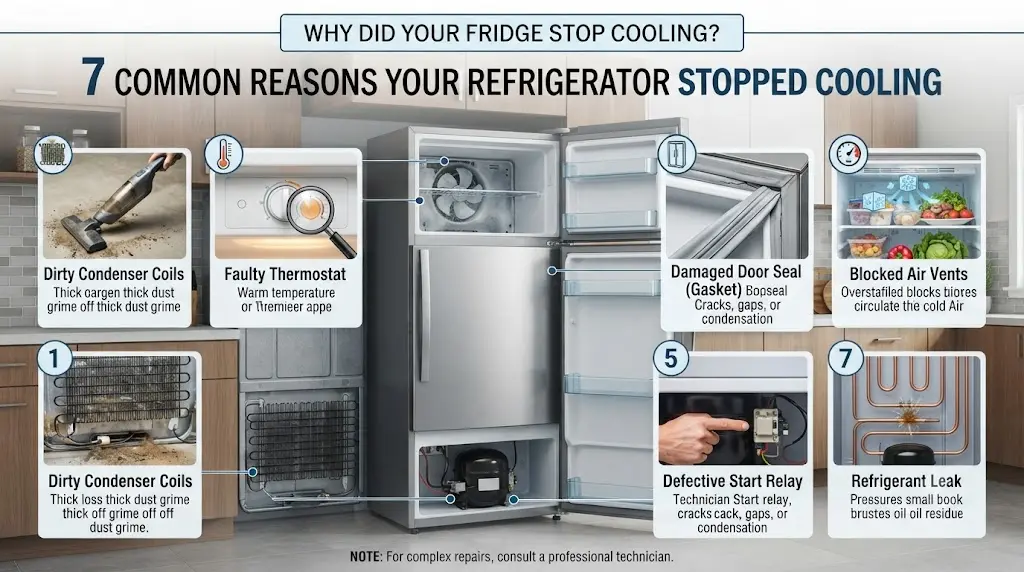
1. Dirty or Blocked Condenser Coils
The condenser coils, typically located behind or underneath the unit, release heat as part of the cooling cycle. When dust, pet hair, and debris build up on them, the refrigerator has to work much harder to stay cold — and eventually, it may not be able to keep up at all.
How to check: Unplug the fridge, locate the coils, and look for visible dust buildup. A vacuum with a brush attachment usually clears this in a few minutes.
2. A Faulty Condenser Fan Motor
The condenser fan pulls air across those coils to help dissipate heat. If the fan motor burns out or gets obstructed by debris, heat has nowhere to go, and cooling performance drops sharply.
How to check: Listen near the back or bottom of the unit while it’s running. Silence where you’d normally expect a soft whirring sound can point to a fan that’s no longer spinning.
3. Evaporator Fan Problems
Located inside the freezer, the evaporator fan circulates cold air throughout both the freezer and refrigerator compartments. If this fan fails, the freezer may stay cold while the refrigerator section warms up a telltale sign this is the culprit.
4. A Refrigerant Leak
Refrigerant is what actually absorbs and removes heat from inside the unit. If there’s a leak in the sealed system, cooling capacity drops gradually or disappears entirely, even though the compressor may still be running. This is one of the more serious causes, since refrigerant issues require certified handling and can’t be safely diagnosed or repaired without the right tools.
5. A Failing Start Relay or Compressor
The compressor is the heart of the cooling system, and it depends on a small component called the start relay to kick into gear. If the relay fails, the compressor may not start at all leading to a fridge that runs but never actually cools. A worn-out compressor itself is a more expensive fix and is more common in units that are already 8–10+ years old.
6. A Broken Door Seal
A worn, cracked, or loose door gasket lets cold air escape and warm air seep in, forcing the refrigerator to run constantly just to maintain temperature. Over time, this strain can also shorten the lifespan of other components.
Quick test: Close the door on a piece of paper or a dollar bill. If it slides out with little resistance, the seal likely needs replacing.
7. Thermostat or Control Board Issues
Modern refrigerators rely on a thermostat and control board to regulate temperature. If either malfunctions, the unit may not signal the compressor or fans to run properly, even though every other component is technically working fine.
Is It the Fridge Section or the Whole Unit?
One useful clue: if your freezer is still cold but the refrigerator section isn’t, the issue is more likely tied to airflow (like the evaporator fan) rather than the compressor or refrigerant system. If both sections are warm, the problem is more likely rooted in the compressor, refrigerant, or condenser system as a whole. This distinction can save a lot of guesswork before calling for repair.
What to Do Right Away
While you sort out the cause, a few quick steps can limit food loss:
- Keep the doors closed as much as possible to preserve remaining cold air
- Move perishables to a cooler with ice if the fridge has been warm for more than an hour
- Avoid restocking the fridge until the issue is diagnosed, since new items will warm faster than they cool
Why This Happens More Often in San Antonio
Summer heat means refrigerators run longer and harder just to maintain a safe internal temperature, which puts extra strain on compressors, fans, and seals. San Antonio’s hard water can also affect ice makers and water lines over time, which is worth mentioning to your technician if your fridge has a built-in dispenser.
When to Call a Professional
Cleaning coils or replacing a door seal are reasonable DIY fixes. Anything involving refrigerant, the compressor, or the control board should be left to a certified technician not just because of the complexity, but because mishandling refrigerant is both a safety and environmental concern.
Pro Appliance Repair offers same-day refrigerator diagnostics across San Antonio, Stone Oak, Alamo Heights, Leon Valley, Helotes, and nearby areas, with upfront pricing before any work begins.
FAQ's
Why is my fridge not cold but the freezer is fine?
This usually points to a blocked or failing evaporator fan, which is responsible for circulating cold air into the refrigerator compartment specifically.
Can a refrigerator stop cooling suddenly with no warning?
Yes, particularly with electrical failures like a bad start relay or control board issue. Gradual causes like dirty coils or a worn seal, on the other hand, tend to show smaller warning signs first.
Is it worth repairing a refrigerator that stopped cooling?
In most cases, yes, especially for units under 8–10 years old. A technician can confirm whether the repair cost makes sense compared to replacement.
How long can food stay safe in a warm refrigerator?
The FDA generally recommends discarding perishable food that’s been above 40°F for more than two hours, so it’s worth checking food safety promptly if your fridge has been warm for a while.
Refrigerator not cooling like it should?
Schedule a repair with Pro Appliance Repair today or call +1 (726) 264-9100 before more food is lost.